You have meeting notes in three different apps. A voice memo from last week that you swear you'll transcribe. A PDF full of highlights you never reviewed. And somewhere in your Downloads folder, a half-finished summary you wrote at 2 a.m.
This isn't disorganization. It's the natural outcome of trying to capture thoughts faster than your system can contain them.
The real problem isn't that you take bad notes—it's that the notes you take live in different formats, different places, and different levels of completeness. You end up with a fragmented archive that's more stressful to maintain than useful to reference.
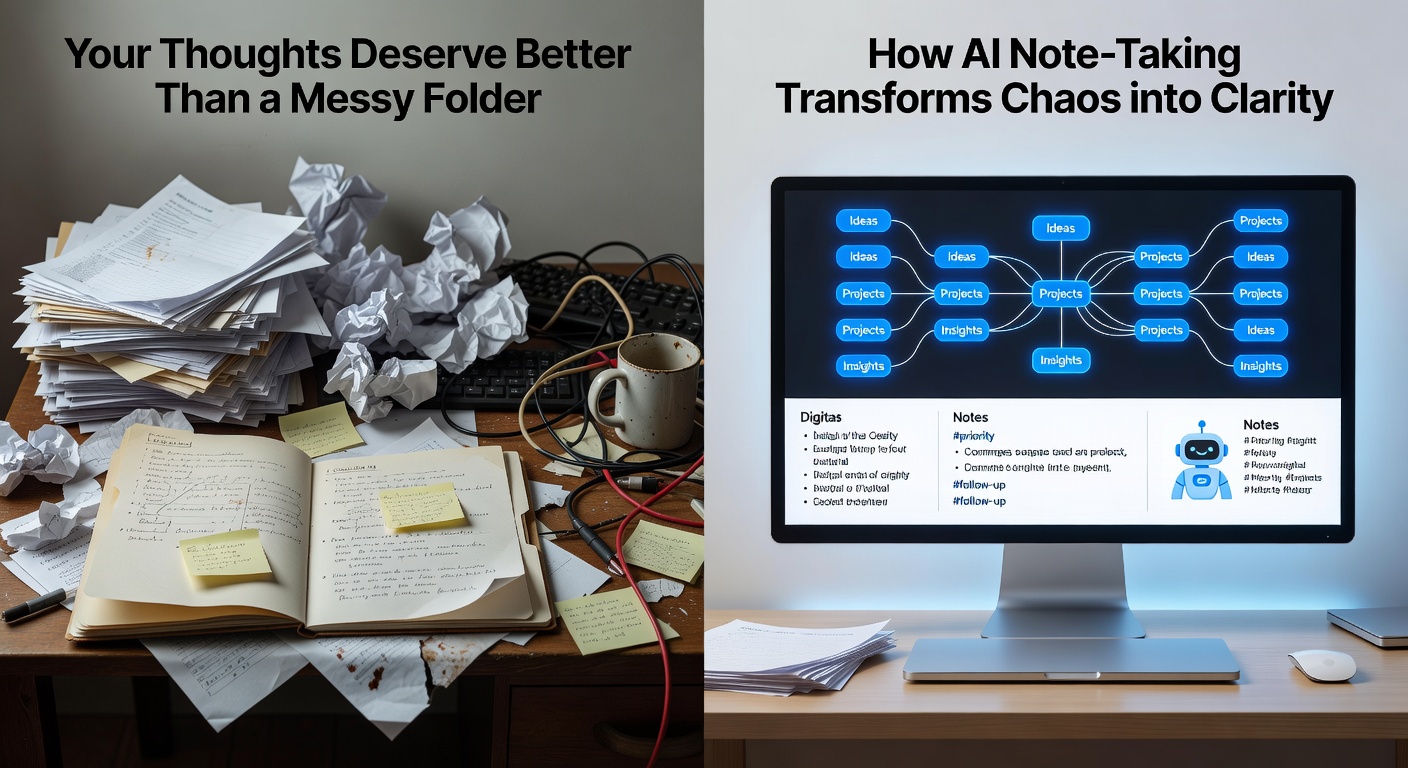
What AI note-taking actually solves
Tools like Beanly don't just transcribe audio or generate summaries. They collapse the distance between capturing and organizing. You record a meeting or a lecture, and within seconds you get a structured output: bullet points, key decisions, action items. The messy, half-formed raw material becomes something you can immediately act on.
The practical effect is subtle but real. Instead of having to re-listen to a 45-minute recording searching for one decision, you scan a summary. Instead of wondering whether that voice memo from two weeks ago contains something important, you know—because the AI already extracted the signal from the noise.
Three scenarios where the difference shows
Team meetings with rapid subject shifts. You're in a product review where the conversation jumps from engineering timelines to customer feedback to budget constraints. Human note-taking lags behind real discussion—you either miss something or write incomplete fragments. Beanly captures everything and organizes it into categories the AI identifies, not just a chronological wall of text.
Research reading. You're working through a stack of academic papers or industry reports. Traditional approaches involve highlighting, copying quotes into a document, then summarizing later. That "later" rarely comes. AI note-taking lets you paste in the content, get a concise summary, and tag it for retrieval without ever opening a separate folder or filing system.
Lecture or class review. You're attending a seminar or online course. Your own notes are fine during the session, but a week later the context has faded. A generated summary preserves the structure and key points, so you can revisit it months afterward and understand what was said without rebuilding the mental model.
Where the tradeoffs live
AI summaries are not perfect. They flatten nuance—a passionate disagreement in a meeting becomes "differing perspectives noted." They occasionally misinterpret industry-specific jargon. And they never capture the tone, the pause, the implicit hesitation that a human observer would register.
If your work depends on reading emotional subtext or interpersonal dynamics, an AI summary alone isn't enough. You'll still need the raw recording or your own observational notes.
The other limitation is trust calibration. You have to use a tool long enough to understand its error patterns. Some apps over-summarize, stripping useful context. Others under-summarize, leaving too much noise. Beanly leans toward structured clarity, which works well for most business and academic use cases, but you should test it against your specific content type before relying on it fully.
How to evaluate fit
Ask yourself two questions: First, do you spend more time organizing notes than actually using them? Second, do you lose information because you can't find it when you need it? If yes, AI note-taking is worth adopting—not as a replacement for thinking, but as a bridge between capture and action.
Start with one recurring use case. Try using it for your weekly team meeting for two weeks. Compare the time you spend reviewing notes now versus before. The metric isn't "did the AI get everything right"—it's "can I find what I need faster and with less friction."
Your thoughts deserve better than a messy folder. Not because organization is virtuous, but because the energy you spend managing fragments is energy you can't spend on the actual work.
Comments
Leave a Comment