You know that feeling. You're walking down the street, half-listening to a podcast, and your brain serves up the most absurd joke you've ever thought of. Or maybe you're in the shower and you just connect two completely unrelated ideas into a hilarious theory about why cats always sit on your keyboard. These are the silly thoughts that make life worth living. And then, thirty seconds later, you've forgotten them.
That's where Beanly comes in. Most AI note-taking tools are built for productivity: meeting minutes, lecture transcripts, research summaries. They treat your mind like a filing cabinet. Beanly works differently. It treats your mind like a playground. You can dump whatever random, half-baked, weird thought you have into it, and instead of cleaning it up into a sterile bullet point, it turns it into a little memory capsule. A fun one.
How Silly Thoughts Become Shareable Stories
Here's a real example. Last week I had a thought while waiting for my coffee: "What if pigeons have a secret language that sounds like traffic to us?" I opened Beanly, said that exact sentence out loud, and hit record for about 90 seconds while I rambled about pigeon politics. Beanly spat back a short, playful narrative titled "The Secret Society of Sidewalk Birds." It wasn't just a transcription. It added a tiny bit of structure and tone—enough to make it readable, but not so much that it killed the silliness.
Another time, I'd been trying to remember a stupid inside joke from a holiday three years ago. I typed a few keywords into Beanly: "bad karaoke, pizza argument, fake Australian accent." The tool reconstructed the memory as a mini story, filling in gaps with context from my other notes and the date stamp. It didn't get it exactly right—the accent was apparently Canadian, not Australian—but it gave me enough to laugh and then text my friend the real version. The AI started the fun; I finished it.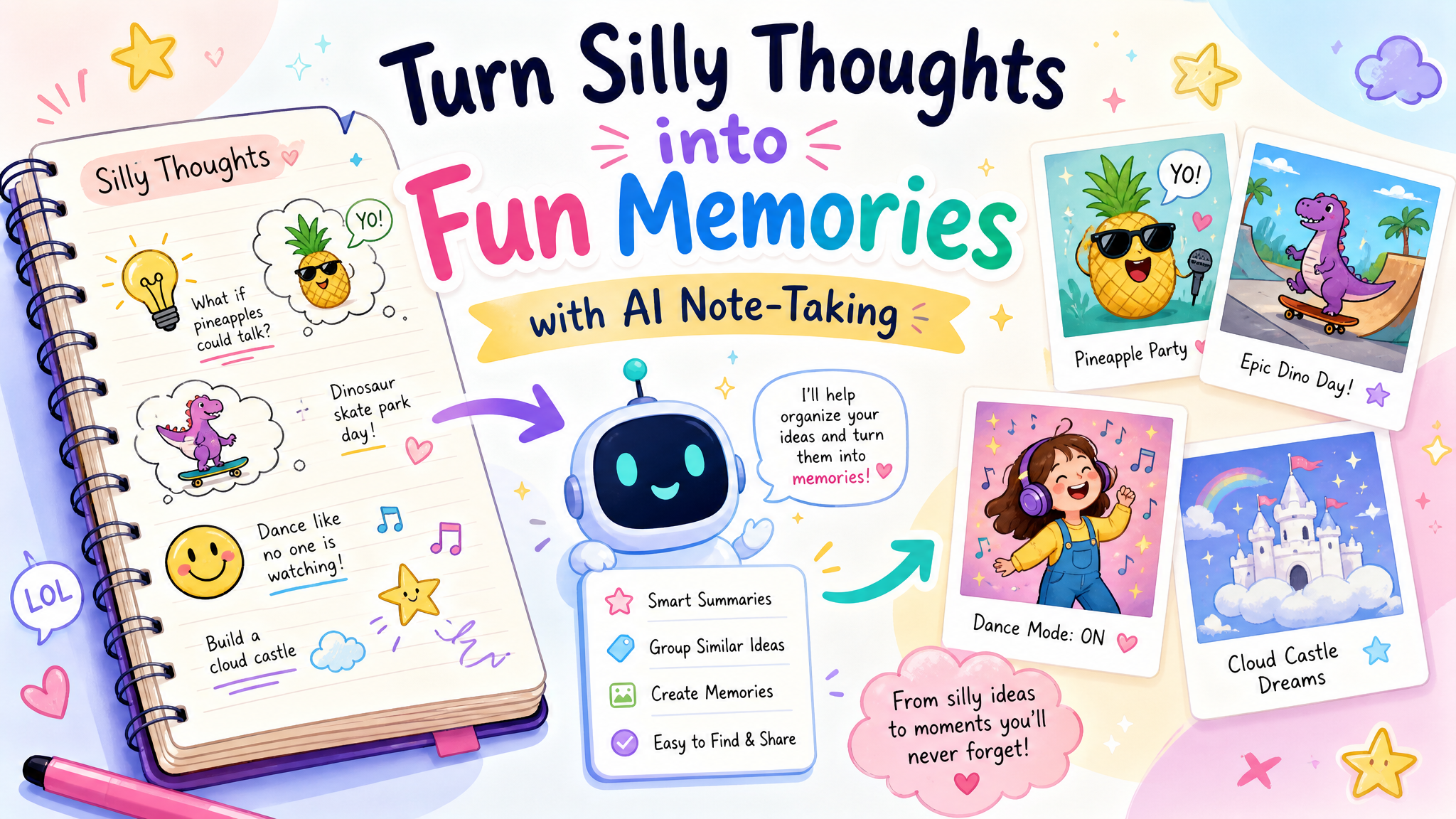
The Tradeoff: Fun vs. Fidelity
This is where you need to be honest with yourself. Beanly is not a perfect memory capture tool. If you want a precise, verbatim log of your thoughts, you'll be disappointed. The AI summarizes and reframes. That's the whole point—it turns raw rambling into something more polished and shareable. But that also means it will sometimes sand off the weird edges of your original thought. A truly bizarre tangent might get smoothed into something more coherent, losing the very thing that made it funny.
My recommendation: use it for the spark, not the record. Dictate your silly thought, let Beanly turn it into a fun little memory. Then, if the original was a specific phrase or joke that you love, write that down separately as a tag or annotation. The tool gives you a great starting point, but the real gold is still in your head. You have to participate.
When It Works Best
Beanly shines in two scenarios. First, quick voice notes when you're on the move—walking, driving, cooking. The less you have to type, the better. Second, when you have a collection of random ideas from a trip, an event, or just a funny week. Feed them all in at once, and Beanly can weave them into a little "chapter" of memories. It's not a replacement for a journal, but it's a much lower barrier to actually writing one.
The final practical tip: set aside five minutes at the end of your day, open Beanly, and just ramble about the stupidest thing that happened. Don't try to be clever. Don't edit yourself. See what comes out. You might be surprised how much of your life you're forgetting simply because you never gave it a voice.
Comments
Leave a Comment