You open the meeting recording, trying to find the deadline the project manager mentioned half an hour ago. You drag the progress bar three times, only to hear the coffee machine noise from the next desk and colleagues coughing. So true. The problem with most meeting audio tools is that they only "record" and never "read". You end up with a one-hour audio file instead of a clear conclusion.
I recently tried tidenote. It's not the old "record first, figure it out later" approach; instead, it directly does structured output while recording. Simply put, it cuts out the "go back and organize" step, giving you real-time key points during meetings, classes, or research. After using it for a few weeks, it's worth discussing how much it actually helps and where it falls short.
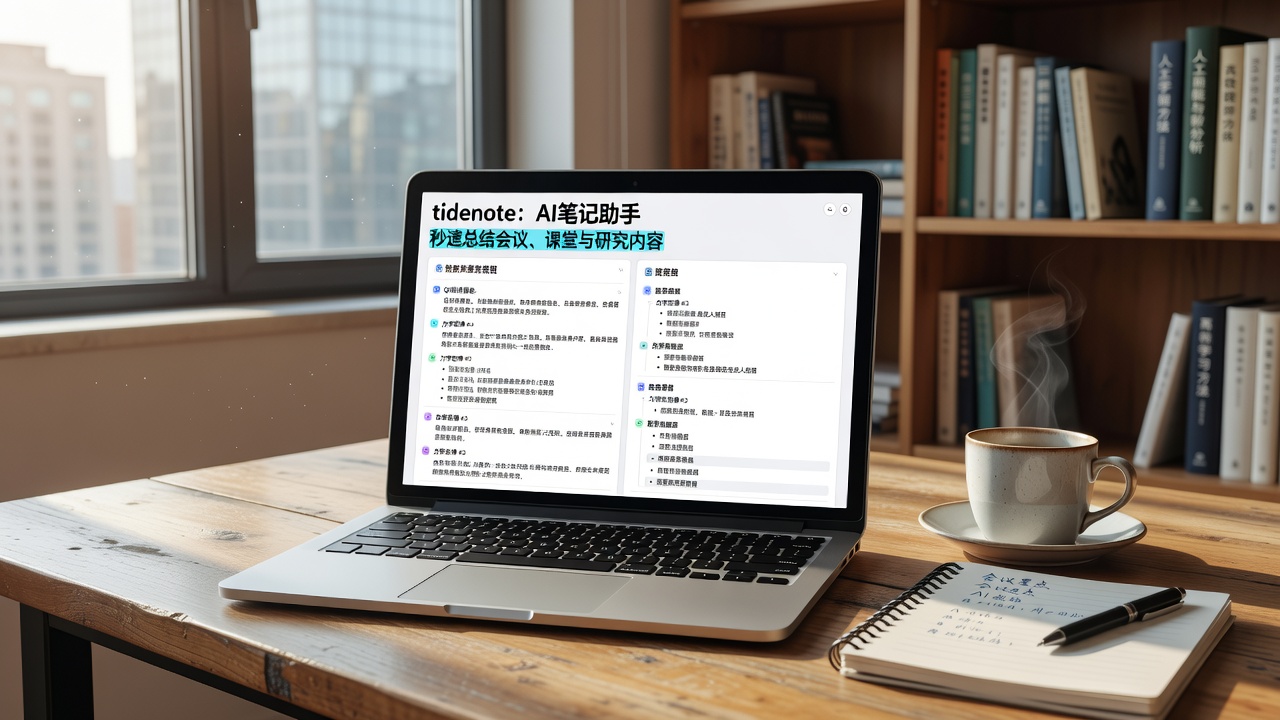
Three Most Frequently Used Scenarios
Let me start with my most common use case — weekly meetings. You know, the kind where multiple people take turns reporting, with very low information density. Previously, I would grimly jot down keywords and then redo it with the recording at home. Now I just record directly with tidenote, and it automatically associates names with their speech content. Last week, my boss mentioned three priorities for the next quarter, and the tool directly extracted them into three "decision points", instead of me having to dig through a bunch of "uh", "well", "let me think again". For me, this feature alone is worth saving a commute time.
The second scenario is classes and online courses. I occasionally listen to online sharing sessions by industry experts — fast-talking, lots of jargon, heavy information. tidenote's summary function can compress an hour of content into something readable in one or two minutes. But note, not all content is suitable for "compression". Some courses explain reasoning logic and thought processes; after compression, only the conclusion remains, and the causal relationships in between are lost. It works well for "speed-reading" learning needs, but for "comprehension-type" content, I still have to go back and listen to the original.
The third is research papers and long articles. Paste in a dozen-page PDF or a long blog post, and let it generate a summary. I tried this several times, and the quality depends on the text type. Structured, clear-layered analytical articles yield good summaries; but for very literary pieces or soft articles built on examples, the summary tends to pick secondary information. So it's more suited for "getting the skeleton" rather than replacing reading.
Know Its Limits to Use It Well
Every tool has its weaknesses, and tidenote is no exception. First, a practical issue: recording quality directly affects output. I recorded once in my quiet home study, and the result was excellent — key points were accurately extracted. But when I recorded a meeting in an open-plan workspace with people chatting nearby, it also picked up the nearby chatter, and the extracted points were mixed with completely irrelevant content. This is not unique to tidenote; it's a common limitation of all voice-based tools. However, if you have high accuracy requirements (e.g., for lawyers, auditors, medical meetings), current AI note tools including tidenote are not yet fully reliable.
The second point is language mixing. I occasionally attend classes with a mix of Chinese and English. tidenote performs well in pure English and pure Chinese environments, but when you use phrases like "this roadmap needs to be aligned" as a normal expression, its extraction occasionally misses key transition words, giving the conclusion a slight "fail" feeling. It's not unusable, but you need to give it an extra glance to correct.
Third, it suits "high-frequency note takers", not those who "occasionally need to take notes". If you only have two meetings a week, handwriting or simple recording is enough, not worth adopting another tool for low-frequency needs. But if, like me, you deal with three or four meetings a day plus a pile of learning materials, then the organization time it saves is real.
A simple way to judge if it's for you: Are you the person who always asks, "What was that date we just talked about?" after a meeting? If yes, it's worth a try.
Comments
Leave a Comment